The Dark Side of Static Calendars: Why Adaptive Tracking is the Future
For over a century, the medical establishment has based its understanding of the menstrual cycle on a single, clean number: 28.
We’ve been taught that a "normal" cycle should last exactly 28 days, with ovulation occurring like clockwork on Day 14. This 28-day standard is the foundation of almost every period tracking app on the market today. You open the app, it counts 28 squares on a calendar, and it tells you when your period is coming.
But there is a dark side to this "static tracking."
The reality is that only about 15% of people actually have a 28-day cycle. For the other 85%, cycles can vary from 21 to 35 days, and even a single individual’s cycle can fluctuate month to month based on stress, travel, illness, and aging.
When you use a static calendar app, it isn't actually tracking you. It is tracking a mathematical average that might not apply to your biology at all.
The "Standard Deviation" Problem
Static calendars are built on a "linear" logic. They assume that if your last cycle was 28 days, your next one will be too.
But your body doesn’t work linearly. It works in a state of constant, adaptive "homeostasis." Your brain is constantly communicating with your ovaries, adjusting hormone production in real-time based on your environment.
Why Static Apps Fail:
- Late Period Panic: A static app might tell you that your period is "three days late" simply because you ovulated a few days later than the 28-day average. This creates unnecessary anxiety for millions of users every month.
- Mismatched Advice: If a static app thinks you’re ovulating but you’re actually still in your follicular phase, its wellness, exercise, and diet advice based on cycle syncing will be completely wrong.
- The Irregularity Stigma: By centering "28 days" as the "normal" standard, these apps pathologize anyone who falls outside that range. Millions of people are led to believe their bodies are "broken" simply because they don't match an arbitrary average.
The Next Frontier: Adaptive, Bayesian Tracking
The future of femtech isn't about better calendars; it's about better math.
Instead of a linear count, modern tracking should use Bayesian Logic. This is a form of statistical inference that looks at "prior" data (your history) and "new" evidence (your symptoms, basal body temperature, or cervical mucus logs) to continuously update its predictions.
How Adaptive Tracking Works:
- It Learns You: The more you track, the more Bloom's Bloom AI understands your unique variance. If your follicular phase is typically longer than 14 days, the app adjusts its "summer" predictions accordingly.
- It Respects Variance: Bloom doesn't view a 32-day cycle as "wrong." It views it as your rhythm.
- It Updates in Real-Time: If you log symptoms that suggest you haven't ovulated yet, an adaptive app won't keep telling you that your period is coming in three days. It will shift its predictions dynamically.
The "Liquid Light" Experience
At Bloom, we believe that an adaptive internal state needs an adaptive external interface.
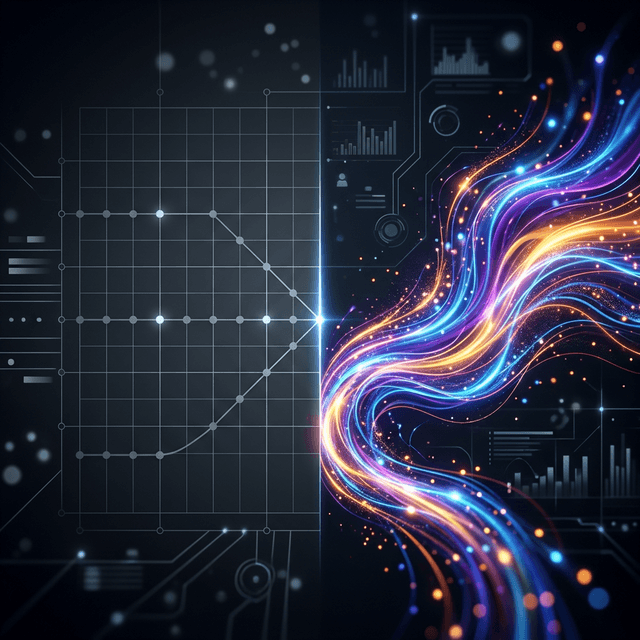
This is why we moved away from the static, calendar-grid UI. Our "Liquid Light" design philosophy is built on the idea of a "Pulse." The interface isn't a collection of static boxes; it’s a living, breathing visualization of your biological state.
When your hormones shift, the very physical feel of the app shifts with them. It’s an intuitive, visceral way to stay connected to your body that doesn't rely on counting days on a flat screen.
Privacy is the Foundation of Accuracy
You cannot have truly adaptive tracking without the user's trust. For an AI to learn your patterns, you need to feel safe logging your most intimate symptoms.
Many apps sell this deeply personal data to advertisers. This creates a "chilling effect" where users stop being honest with their tracking to protect their privacy.
This is why Bloom’s Local-First, End-to-End Encrypted architecture is so important. When you know your data stays on your device, you are empowered to be fully honest. This honesty provides the high-quality data that Bloom AI needs to provide truly accurate, adaptive insights.
Transitioning to the Future
The era of the "standard" 28-day cycle is over.
It’s time to stop trying to squeeze your complex, beautiful biology into a rigid, 100-year-old calendar model. Whether your cycle is 24 days or 40, Bloom is built to see you.
Embrace the adaptive future. Stop counting days and start feeling your rhythm.
Read on the go.
Stop scrolling and start syncing. Download the free Bloom app for personalized daily insights right on your phone.